How Casino Imagery Frames Bà Rịa–Vũng Tàu
See how casino imagery frames Bà Rịa–Vũng Tàu, and separate a media story about glamour or risk from what the scene actually establishes.
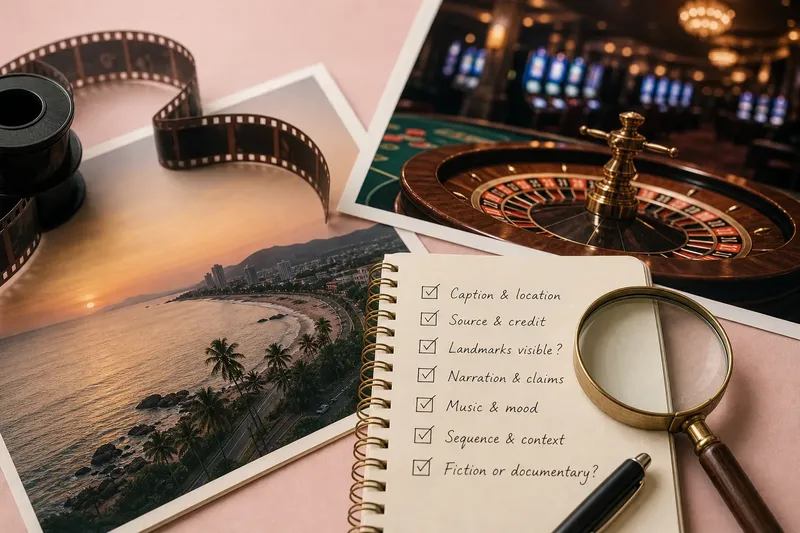
Casino imagery frames Bà Rịa–Vũng Tàu through more than a setting: music, captions, and the order of shots can cast the region as glamorous, risky, or mysterious. Those choices shape an audience’s impression even when the story is really about a character, not a place.
A roulette wheel is like a prop key on a table: it hints at a story but does not tell you which door opens. To read the frame, ask what the image invites you to feel, who or what the scene makes visible, and which parts of the region it leaves out.
Casino imagery frames regional identity through mood
A casino scene can give a film or social post a ready-made atmosphere. Neon, green felt, a guarded entrance, and a slow camera move may suggest wealth, secrecy, risk, or spectacle; a quiet shot of someone waiting can instead make the same setting feel lonely.
These associations belong first to the story’s visual language. When a place name appears nearby, the mood can cling to that name, too. That does not mean the image describes how residents see their region; it means the edit has linked a familiar symbol with a particular place.
Sound and sequence decide what a casino scene seems to mean
A quick cut from a shoreline to casino lights may make both images feel like parts of one scene. A caption can strengthen the connection, while suspenseful music may make an ordinary entrance feel secretive. The audience receives a composed sequence, not a neutral inventory of local life.
Consider how the meaning changes if the same casino shot follows a character’s worried expression rather than a coastal view. In the first sequence, it may suggest personal pressure; in the second, it may suggest a regional nightlife story. The images have not changed, but their neighbors have.
Editorial choices can make the frame clearer
Imagine an editor has a dusk shoreline clip identified as footage from Bà Rịa–Vũng Tàu and a separate licensed casino scene with no confirmed local connection. The editor places the casino scene after the shoreline, adds the district’s name, and uses ominous music. Viewers may read the result as a claim about local nightlife, although the footage does not establish that relationship.
To make the distinction visible, the editor removes the regional caption from the casino shot, identifies the scene as illustrative footage, and keeps the location label with the verified shoreline clip. The audience can then read the casino image as part of the film’s mood rather than as a depiction of the named place.
This revision also changes whose story the clip tells. Instead of using a region as shorthand for danger or glamour, it lets the casino scene carry its own narrative role and gives local imagery a separate context.
Read casino imagery in Bà Rịa–Vũng Tàu with specific checks
When a post or film connects casino imagery with Bà Rịa–Vũng Tàu, record what is actually present before repeating its implied story. Each observation points to a decision about how confidently to describe the frame:
- Check the caption for a named district or venue. If it names one and the source supports that connection, describe the claim with its source; if not, call the shot casino imagery without assigning it to that location.
- Check the source credit for a film, stock library, or local recording. If it identifies illustrative or fictional material, describe it as such; if the source is absent or unclear, do not present the shot as local documentation.
- Check the image for a recognizable landmark. If one is visible and independently identified, say only what that landmark supports; if none is visible, do not infer a location from a generic coastal view.
- Check the narration for words such as “local,” “nearby,” or “regional.” If it makes a factual connection, look for location-specific support before repeating it; if it offers no support, describe the connection as the narrator’s framing.
- Check the soundtrack and cut for suspense, glamour, or menace. If these elements steer the mood, describe that as an editorial choice; if they are absent, avoid adding a dramatic tone the scene does not convey.
- Check what appears immediately before and after the casino shot. If a place name or landmark creates an implied link, explain that the sequence suggests a connection; if the surrounding shots focus on a character, keep the reading centered on that character.
- Check whether the clip distinguishes a dramatization from documentary footage. If it does, preserve that distinction when summarizing it; if it does not, avoid presenting the scene as evidence of regional conditions.
What does a casino scene establish about a place?
Does a casino image prove the venue is local?
No. A shot can establish that a casino appears in the media item, but a location claim needs information tying the footage to a specific place. A caption or coastal backdrop alone may not provide that connection.
How can you tell if footage is illustrative?
Check credits, captions, and narration for terms such as stock footage, dramatization, or reenactment. If those details are missing, describe what the scene shows without assigning it a documentary role.
Why does the order of shots matter?
Viewers often connect neighboring images, especially when a place name or landmark appears beside a casino scene. That sequence can imply a relationship even when no sentence states one.
Can a casino scene still say something meaningful?
Yes: it can reveal a character’s fears, ambitions, or relationship to risk, or establish a story’s tone. Those interpretations concern the work’s choices; they do not automatically describe Bà Rịa–Vũng Tàu.
Separate the media frame from the regional story
When casino imagery frames Bà Rịa–Vũng Tàu, distinguish the scene’s emotional work from its claims about a community. The image may be vivid and purposeful while leaving local identity, geography, and everyday experience outside the frame.
Before repeating the association, name the part you can support: the shot’s mood, its sequence, or its stated source. That small distinction keeps a dramatic story legible without letting its atmosphere stand in for a region’s own account of itself.